QGM ZN2000-2: Advancing Solid Waste Recycling for Green Building Materials
As green building materials and the circular economy continue to develop, converting industrial solid waste such as fly ash, slag, and mineral residues into useful building materials has become an important approach for manufacturers pursuing more sustainable production.
For regions with abundant industrial solid waste resources, however, resource utilization involves more than simply finding a way to consume waste materials. Manufacturers also need to address differences in material characteristics, diverse product requirements, production stability, and the complexity of manual operations. This creates a need for more intelligent and efficient equipment capable of consistently converting industrial solid waste into hydraulic blocks, municipal paving blocks, and wall blocks.
A green building materials manufacturer in Xinjiang has long focused on the development and production of low-carbon building materials. The company primarily uses industrial solid waste, including fly ash, slag, and mineral residues, together with locally available resources as raw materials. Its product portfolio covers hydraulic blocks, municipal paving blocks, wall blocks, and other concrete products. As its business expanded, the company required greater industrial solid waste utilization capacity, higher production automation, and stronger flexibility for manufacturing different types of concrete blocks.
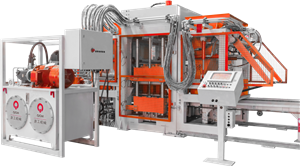
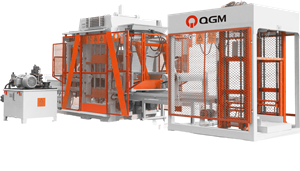
To address these requirements, the company introduced a QGM ZN2000-2 fully automatic production line with a new-energy rack system in 2024. Once operational, the project is capable of utilizing 200,000–250,000 tonnes of industrial solid waste annually, including fly ash, slag, and mineral residues, and converting these materials into a range of environmentally friendly building products. The project provides a practical approach to integrating industrial solid waste utilization with green building materials production.
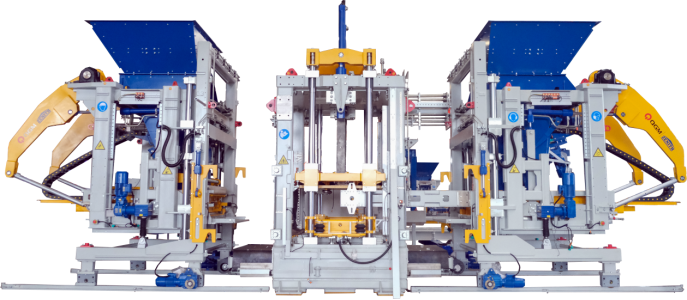
△ QGM ZN2000-2 Fully Automatic Production Line for Solid Waste Recycling
What Production Challenges Arise When Turning Industrial Solid Waste into Concrete Blocks?
For block manufacturers using industrial solid waste as a major raw material, the availability of these materials does not necessarily mean that production is straightforward.
Fly ash, slag, mineral residues, and other industrial solid waste materials can have different physical and processing characteristics. During production, manufacturers need to organize and proportion raw materials according to the requirements of different products while ensuring a stable material supply to the forming process. Uneven material distribution, insufficient material flow, or unstable forming parameters can affect block density and finished-product quality.
The project also produces several categories of concrete products, including hydraulic blocks, municipal paving blocks, and wall blocks. Different products require different molds and forming processes. If product changes rely heavily on manual adjustments, they can increase operator workload and affect overall equipment utilization.
As the scale of industrial solid waste utilization grows, the need for automated production, stable equipment operation, and digital production management also becomes more important. The project therefore required more than a standalone block making machine. It needed an integrated production solution capable of supporting industrial solid waste utilization, multi-product manufacturing, automated operation, and intelligent production management.
QGM ZN2000-2: Intelligent Forming Technology for Solid Waste-Based Building Materials
To meet the project's production requirements, QGM supplied a ZN2000-2 fully automatic production line with a new-energy rack system. The solution combines automated production processes with a modular equipment design, connecting industrial solid waste utilization with modern concrete block manufacturing.
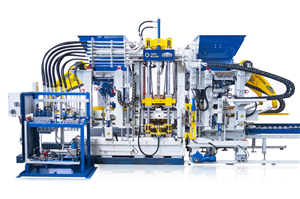
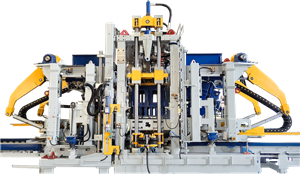
The ZN2000-2 incorporates coordinated systems for vibration and forming, automatic mold changing, material feeding, hydraulic operation, equipment assembly, and intelligent control. Its configuration can be adapted to different concrete product requirements, providing an equipment foundation for multi-product and large-scale production of environmentally friendly concrete blocks.
Optional vibration technologies can be configured according to specific product requirements, while features such as automatic mold changing, an intelligent suspended material feeding system, a hydraulic reciprocating anti-bridging bottom-material carriage, and an intelligent control system further enhance the production line's adaptability in material distribution, forming control, and overall production management.
Key Advantages of the ZN2000-2: From Forming Quality to Intelligent Production
1. Ultra-Dynamic Servo Vibration for Improved Concrete Forming Quality
To accommodate different industrial solid waste materials and concrete block products, the ZN2000-2 can be equipped with either the Zenith Ultra-Dynamic Four-Axis Servo Vibration System or the Zenith Ultra-Dynamic Eight-Axis Servo Vibration System.
The four-axis servo vibration system uses servo drive technology to provide highly responsive and precise vibration control. Vibration parameters can be accurately matched to different product requirements, helping improve concrete material filling while allowing vibration amplitude and rotational speed to be adjusted independently for stable excitation.
The eight-axis servo vibration system uses real-time feedback to precisely control vibration phase and operating speed, enabling high-speed standby, high-frequency vibration, and intelligent adjustment. Coordinated pre-vibration, transition vibration, and main vibration processes support the efficient forming of large concrete products, high-strength blocks, and high-quality paving products.
For solid waste-based building materials, stable vibration control helps the forming process better accommodate different material characteristics and product requirements, supporting consistent density and product quality.
2. Intelligent Suspended Material Feeding for More Uniform Material Distribution
Stable material distribution is particularly important when industrial solid waste is incorporated into concrete block production. The ZN2000-2 uses a modular intelligent suspended material feeding system integrating the face-mix feeding device, base-material feeding system, scraping mechanism, tamper-head cleaning device, and anti-bridging system.
The modular design facilitates maintenance and adjustment while supporting more uniform and efficient material distribution. By improving the feeding process, the system helps enhance mold filling and reduce production fluctuations, supporting stable forming across different concrete block products.
3. Hydraulic Reciprocating Anti-Bridging Bottom-Material Carriage for Better Material Flow
Stable material conveying and feeding are important parts of the forming process when industrial solid waste is used as a production material.
The ZN2000-2 uses a hydraulic reciprocating anti-bridging bottom-material carriage. Its hydraulically driven rake moves back and forth to improve bottom-material flow and reduce material bridging, helping deliver the material more consistently to the forming stage.
This design addresses material flow issues that can occur during feeding and supports more continuous and stable production line operation.
4. Automatic Quick Mold Change for Multi-Product Manufacturing
The project produces hydraulic blocks, municipal paving blocks, and wall blocks. This diversified product portfolio requires a production line with the flexibility to switch between different products.
The ZN2000-2 features an intelligent automatic quick mold change system. Multiple mechanisms work together to automatically position, change, and lock molds, reducing manual intervention and adjustment time.
For manufacturers producing different types and specifications of concrete products, automatic mold changing provides greater production flexibility and helps improve overall equipment utilization.
5. Modular Machine Design for Easier Maintenance
In an industrial production environment, maintenance accessibility can have a direct impact on production organization and equipment availability.
The ZN2000-2 adopts a modular assembled frame design, with key components such as the vibration table, motor beam assembly, and feeding frame using high-strength bolted connections. This modular structure facilitates equipment inspection and component replacement while reducing the complexity of maintenance operations.
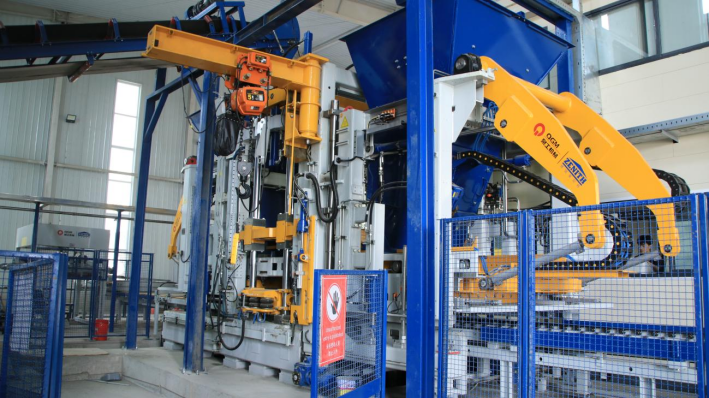
The standardized and modular equipment structure provides a more convenient basis for long-term operation and subsequent maintenance.
6. Intelligent Control and Cloud Services for Digital Production Management
The ZN2000-2 is equipped with a Siemens S7-2000 series PLC control system, combined with a visual human-machine interface for real-time display of production parameters, equipment status, and operating information.
QGM also provides digital equipment management through its Intelligent Equipment Cloud Service Platform, enabling online equipment monitoring, remote system upgrades, fault prediction, operating data analysis, and equipment health assessment.
For manufacturers engaged in large-scale industrial solid waste utilization, these digital functions improve equipment visibility and provide data support for production management and equipment maintenance.
What the Xinjiang Project Shows About Global Solid Waste Recycling Demand
The Xinjiang project reflects a broader development trend rather than an isolated market phenomenon. Around the world, the recycling and resource utilization of industrial solid waste, construction and demolition waste, and concrete waste are becoming increasingly relevant to the circular economy and green building materials.
Europe is one of the more mature markets in this area. The European Commission reports that construction and demolition waste (CDW) accounts for more than one-third of all waste generated in the European Union. This waste stream includes materials such as concrete, bricks, wood, glass, metals, and plastics. The EU has identified CDW as a priority waste stream and promotes reuse, high-quality recycling, and material recovery as part of its circular economy objectives.
Importantly, the focus in mature European markets is moving beyond basic waste disposal toward improving the quality and value of recovered materials. Recent EU research indicates that construction and demolition waste accounts for nearly 40% of total waste generated in the EU. Although the EU's 70% recovery target for non-hazardous CDW has been exceeded, part of the recovered material is still used for lower-value applications such as backfilling, leaving further room for higher-quality recycling.
This development suggests that future demand for solid waste recycling equipment may increasingly involve not only waste processing capacity, but also resource conversion, recycled product quality, and large-scale applications. For concrete block manufacturers, converting appropriately processed industrial solid waste, construction waste, or recycled aggregates into concrete products represents a potential extension of the recycling value chain.
Japan has also placed long-term emphasis on the recycling and reuse of construction by-products and construction waste. The Japanese Ministry of Land, Infrastructure, Transport and Tourism (MLIT) has continued to promote construction recycling policies. Through the Construction Recycling Law, Japan has established requirements for the separation and recycling of specified construction materials.
In recent years, Japan's policy direction has also increasingly emphasized improving the quality and value of recycled materials rather than focusing solely on recycling rates. Relevant MLIT planning documents promote higher-value applications for recycled materials and improvements in the quality of construction by-product recycling.
This approach has a clear connection with the production of concrete products from industrial solid waste. After appropriate processing, solid waste can not only reduce the need for final disposal but also enter new product systems as alternative raw materials for building materials manufacturing.
Solid Waste Recycling and Block Manufacturing: A Growing Connection in International Markets
The experience of mature markets such as Europe and Japan shows that solid waste recycling is increasingly connected with construction materials, infrastructure development, and the circular economy rather than being treated solely as an environmental issue.
Similar needs can also emerge in Southeast Asia, the Middle East, South Asia, and other regions experiencing rapid urbanization and infrastructure development. On one hand, urban construction and industrial activities generate increasing volumes of solid waste. On the other, infrastructure development requires substantial quantities of concrete products, paving materials, and wall-building materials.
As a result, the combination of solid waste processing and recycled building materials manufacturing can provide a potential link between environmental management and the building materials industry. However, waste classification systems, material standards, environmental regulations, requirements for recycled materials, and market acceptance vary significantly between countries. Each project therefore needs to be evaluated according to local regulations, raw material conditions, and applicable product standards.
From this perspective, the significance of the Xinjiang project extends beyond its annual utilization of 200,000–250,000 tonnes of industrial solid waste. It demonstrates a practical production pathway in which suitable processing methods and automated block manufacturing equipment are used to convert industrial solid waste into environmentally friendly concrete products with established applications.
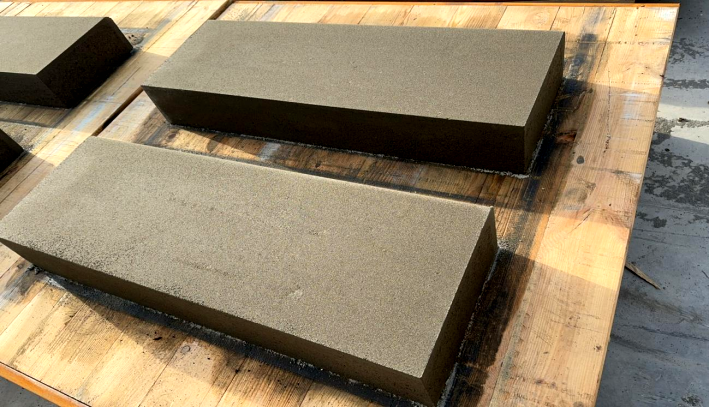
QGM ZN2000-2: Intelligent Equipment for Solid Waste Resource Utilization
For companies engaged in solid waste resource utilization, long-term project performance depends not only on the volume of waste that can be processed, but also on whether raw materials can be introduced consistently into the production system, whether product quality can remain stable, and whether the production line can accommodate changing product requirements.
In this Xinjiang project, the QGM ZN2000-2 integrates ultra-dynamic servo vibration, intelligent suspended material feeding, hydraulic reciprocating anti-bridging technology, automatic quick mold changing, modular machine construction, intelligent control, and cloud-based equipment management to establish an automated and digitalized concrete block production system.
The project can utilize 200,000–250,000 tonnes of industrial solid waste annually, including fly ash, slag, and mineral residues, to manufacture hydraulic blocks, municipal paving blocks, wall blocks, and other environmentally friendly concrete products. This creates an effective connection between industrial solid waste utilization and concrete products manufacturing.
Globally, as circular economy principles, resource efficiency, and green building continue to gain attention, solid waste recycling is expected to remain an important area of development for the building materials industry. For equipment manufacturers, future opportunities may extend beyond conventional block production to the growing need to convert industrial solid waste, construction waste, and recycled aggregates into higher-value concrete products.
QGM will continue to focus on automation, intelligent manufacturing, and resource utilization, providing customers in different markets with flexible block making machines, concrete block production lines, and solid waste recycling solutions. Through intelligent equipment, QGM aims to connect waste resources with green building materials manufacturing and support the continued development of circular economy practices in the concrete products industry.
FAQ
1. Can industrial solid waste be used to manufacture concrete blocks?
Yes. Materials such as fly ash, slag, and mineral residues can be incorporated into concrete block production when their characteristics, processing requirements, mix design, and applicable product standards are properly evaluated.
2. What challenges can industrial solid waste create during block production?
Different solid waste materials can have different physical characteristics and flow behavior. Material distribution, feeding stability, vibration parameters, and forming control therefore need to be properly coordinated to support consistent concrete block quality.
3. How does the QGM ZN2000-2 support solid waste-based block production?
The ZN2000-2 combines technologies including optional ultra-dynamic servo vibration, intelligent suspended material feeding, hydraulic anti-bridging material feeding, automatic quick mold changing, modular machine design, intelligent control, and cloud-based equipment management.
4. Can the ZN2000-2 produce different types of concrete blocks?
Yes. The production line can be configured for different concrete product requirements. In the referenced project, the equipment is used to manufacture hydraulic blocks, municipal paving blocks, wall blocks, and other environmentally friendly concrete products.
5. Why is solid waste recycling becoming relevant to the concrete products industry?
Solid waste recycling is increasingly connected with the circular economy, resource efficiency, and green building materials. Converting suitable industrial solid waste, construction waste, or recycled aggregates into concrete products can connect waste resource utilization with downstream building materials manufacturing.