QGM Zenith 1500: Turning Steel Slag into Value-Added Concrete Blocks
Steel slag is an unavoidable by-product of steelmaking. Its content of metallic iron, free calcium oxide, free magnesium oxide, and other complex components makes treatment and reuse more demanding than the handling of conventional aggregates.
For steel producers, the challenge is not simply how to process steel slag, but how to establish a stable route for its subsequent utilization. An effective solution must connect slag treatment, material preparation, feeding, forming, and concrete product manufacturing.
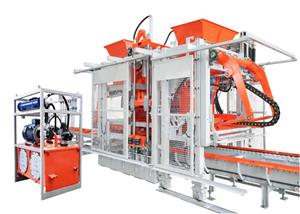
A steelmaking enterprise invested RMB 230 million in a steel slag resource recycling project that combines a pressurized hot-steaming steel slag treatment line with a steel slag residue block production line. The project can process 800,000 tonnes of steel slag solid waste annually. Its residue utilization stage is equipped with the QGM Zenith 1500 fully automatic production line, helping transform treated steel slag residue into useful construction products.
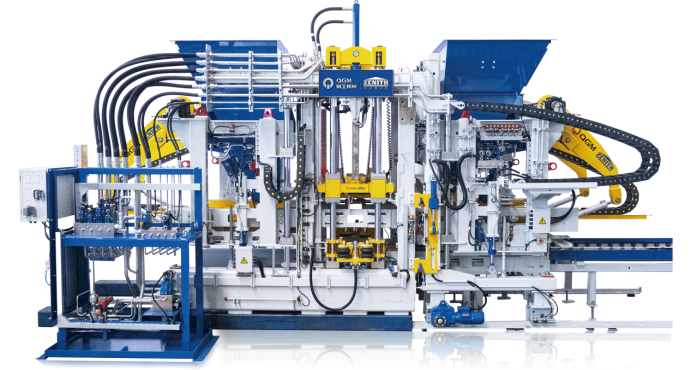
△QGM Zenith 1500 Fully Automatic Production Line for Value-Added Block Production
From Steel Slag Treatment to Concrete Product Manufacturing
Steel slag cannot be directly introduced into a block production process without considering its material characteristics. Particle size, moisture content, surface properties, and chemical composition may influence material flow, mold filling, compaction, and final product quality.
The project therefore adopts an integrated process. First, the pressurized hot-steaming treatment line processes the steel slag. The treated residue is then transferred to the block manufacturing stage, where it is used as a raw material for concrete product production.
This arrangement creates a connection between:
●Steel slag pretreatment
●Residue utilization
●Material batching and feeding
●Vibration forming
●Product conveying
●Product stacking
By linking these stages, the project extends steel slag management beyond basic treatment and introduces a value-added utilization route through an automatic concrete block production line.
Why Forming Performance Matters When Using Steel Slag Residue
The characteristics of steel slag residue can differ from those of ordinary natural aggregates. Variations in particle shape, material flowability, and moisture may affect the consistency of the forming process.
For this reason, the performance of the block making machine is closely related to the stability of material feeding, compaction, mold filling, and product demolding.
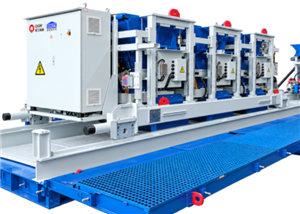
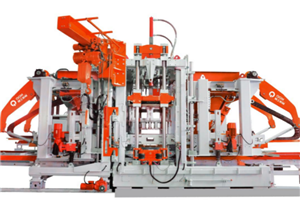
The QGM Zenith 1500 fully automatic production line combines forming technology with centralized automatic control. Batching, material feeding, vibration forming, product transfer, and stacking are coordinated as part of an integrated manufacturing process.
Its main features support the following production requirements.
1. Servo Vibration for More Controlled Compaction
The QGM Zenith 1500 is equipped with a high-efficiency servo vibration system. Its vibration parameters can be adjusted according to product requirements and material conditions.
Controlled vibration helps the mixture compact more effectively inside the mold. When steel slag residue is used as a special aggregate, suitable vibration adjustment can also support more uniform material distribution and more stable forming performance.
This provides a foundation for producing concrete blocks with consistent strength, dimensional accuracy, and surface quality.
2. Forced Feeding for Better Material Distribution
Steel slag residue may have different flow characteristics from conventional aggregates. If material feeding is uneven, mold filling and product consistency may be affected.
The QGM Zenith 1500 adopts a forced-feeding design to actively convey and distribute the material. This helps improve the continuity of material supply and reduce the impact of changes in material flowability.
For a concrete block making machine handling industrial solid waste, stable feeding is an important condition for consistent product formation.
3. Automatic Control for Coordinated Production
The production line uses centralized automatic control to coordinate the main manufacturing stages. Batching, feeding, forming, product transfer, and subsequent handling operate as one connected process.
This configuration helps maintain a more consistent production rhythm, reduces variations associated with manual operation, and supports more efficient production management.
The result is a more systematic operating process for manufacturers producing concrete blocks from treated steel slag residue.
4. Intelligent Monitoring and Remote Technical Support
QGM Zenith equipment can be integrated with an intelligent cloud service system to monitor equipment operating conditions and production information.
The system also supports functions such as remote diagnosis, fault analysis, and maintenance assistance. For a steel slag residue block production line operating continuously, access to equipment information can help operators identify abnormalities earlier and improve troubleshooting efficiency.
These digital functions support more organized equipment management and help maintain stable operation.
5. Flexible Mold Configuration and Easier Maintenance
The QGM Zenith 1500 focuses on equipment reliability and maintenance convenience. Certain key components are designed for easier disassembly and servicing, helping reduce the time required for maintenance and replacement.
Different molds can also be configured according to product requirements. This allows the production line to manufacture concrete blocks, paving products, and other concrete units, depending on the selected product design.
Such flexibility enables manufacturers to adjust product configurations while maintaining the usability of the same automatic block making machine.
Addressing Steel Slag Characteristics Through Process Coordination
Steel slag utilization is affected by the presence of metallic iron, free calcium oxide, and free magnesium oxide. In particular, free calcium oxide and free magnesium oxide may cause volume changes during subsequent applications.
Therefore, the utilization of steel slag residue requires coordination between pretreatment and product-forming technologies. Treatment alone does not complete the recycling process; the processed residue must also be suitable for stable use in concrete product manufacturing.
In this project, the pressurized hot-steaming treatment line is connected with the steel slag residue block production line. The QGM Zenith 1500 then applies controlled feeding, servo vibration, and automated forming technology to the treated material.
Through this process connection, the project successfully addressed key technical challenges associated with steel slag residue block production. The comprehensive utilization rate of steel slag residue reached 100%.
After appropriate treatment, the residue can be introduced into the construction-material production process and converted into concrete products with practical application value. This reduces reliance on conventional storage or off-site disposal and improves the utilization potential of steel slag.
Supporting Steel Slag "Zero Discharge" and Resource Recycling
The project follows China's "Dual Carbon" strategy and promotes the goal of steel slag "zero discharge" by combining slag treatment, residue utilization, and construction-material manufacturing.
With an annual processing capacity of 800,000 tonnes of steel slag solid waste, the project strengthens the ability to process and consume steel slag. The residue block production line also provides an additional application route for treated steel slag in the construction-material sector.
The achieved 100% comprehensive utilization rate of steel slag residue helps reduce the pressure associated with solid waste storage and disposal. At the same time, it demonstrates how a fully automatic concrete block production line can be incorporated into an industrial solid waste recycling process.
By combining suitable material treatment with controlled feeding, stable vibration, and automated forming, the project converts processed steel slag residue into useful concrete products. This provides a practical reference for steel producers seeking to improve resource utilization and support the green transformation of steelmaking.
Conclusion
The effective recycling of steel slag depends on a complete process that connects solid waste treatment with downstream product manufacturing.
With a total investment of RMB 230 million, the project includes a pressurized hot-steaming steel slag treatment line and a steel slag residue block production line. It can process 800,000 tonnes of steel slag solid waste annually and uses the QGM Zenith 1500 fully automatic production line to support residue block production and achieve a 100% comprehensive utilization rate of steel slag residue.
The project demonstrates how steel slag can be moved from treatment and storage toward product-based utilization. It also highlights the role of advanced block making machines, automatic forming systems, and integrated recycling solutions in converting industrial solid waste into useful concrete products.
QGM provides block making machines and integrated solutions for industrial solid waste recycling, helping manufacturers explore the use of steel slag, slag-based materials, and other solid waste in concrete block and paving product manufacturing.
FAQ
1. Why does steel slag require special treatment before block production?
Steel slag may contain metallic iron, free calcium oxide, free magnesium oxide, and other complex components. Its particle size, moisture content, material flowability, and chemical characteristics can affect feeding, compaction, forming, and product stability. Pretreatment is therefore important before residue utilization.
2. What equipment is used in this steel slag recycling project?
The project combines a pressurized hot-steaming steel slag treatment line with a steel slag residue block production line equipped with the QGM Zenith 1500 fully automatic production line.
3. How does the QGM Zenith 1500 support steel slag residue block production?
The QGM Zenith 1500 integrates servo vibration, forced feeding, centralized automatic control, intelligent monitoring, and flexible mold configurations. These functions support material distribution, mold filling, compaction, forming stability, and production management.
4. What is the annual processing capacity of the project?
The project has an annual processing capacity of 800,000 tonnes of steel slag solid waste.
5. What result has the project achieved in steel slag utilization?
By connecting steel slag pretreatment with residue block manufacturing, the project achieved a 100% comprehensive utilization rate of steel slag residue, supporting steel slag resource recycling and the goal of steel slag "zero discharge."